English
 7 min Reading time
 Many people are choosing to take more control of their energy supply, using not only solar panels but also a home battery to store electricity. By now Zonnefabriek has installed hundreds of them, giving us a wealth of experience. Now, at the start of a year in which sales of home batteries are expected to increase even more sharply, we wanted to see what we've learned. What have the existing systems yielded, and what are the important things to consider?
A home battery generates revenue by lowering your energy bill. This can be done in several ways. The simplest method is to store surplus solar power (i.e., the power generated by solar panels but not used immediately) in the battery for later use. This way, you don't have to draw power from the grid not only during the day, but also in the evening and night, sometimes for months on end.
However, this strategy doesn't yield any profit during the winter months, because there's simply not enough solar power "left over" during that period. That's why it's smart to also use batteries in a different way: as a "trading battery."
Trading involves two separate methods. One is trading based on dynamic tariffs, also known as the EPEX spot market or the "day-ahead" market. The other is trading on the "imbalance" market.
Dynamic tariffs (EPEX market) involve taking advantage of the fact that electricity prices change every fifteen minutes. Traders base the quarterly electricity prices on expected demand and supply, and set these prices every day around 2 p.m. for the next 24 hours. You can capitalize on this by charging the battery at the cheapest times and then using only that cheap electricity for the rest of the day, instead of expensive electricity at peak times.
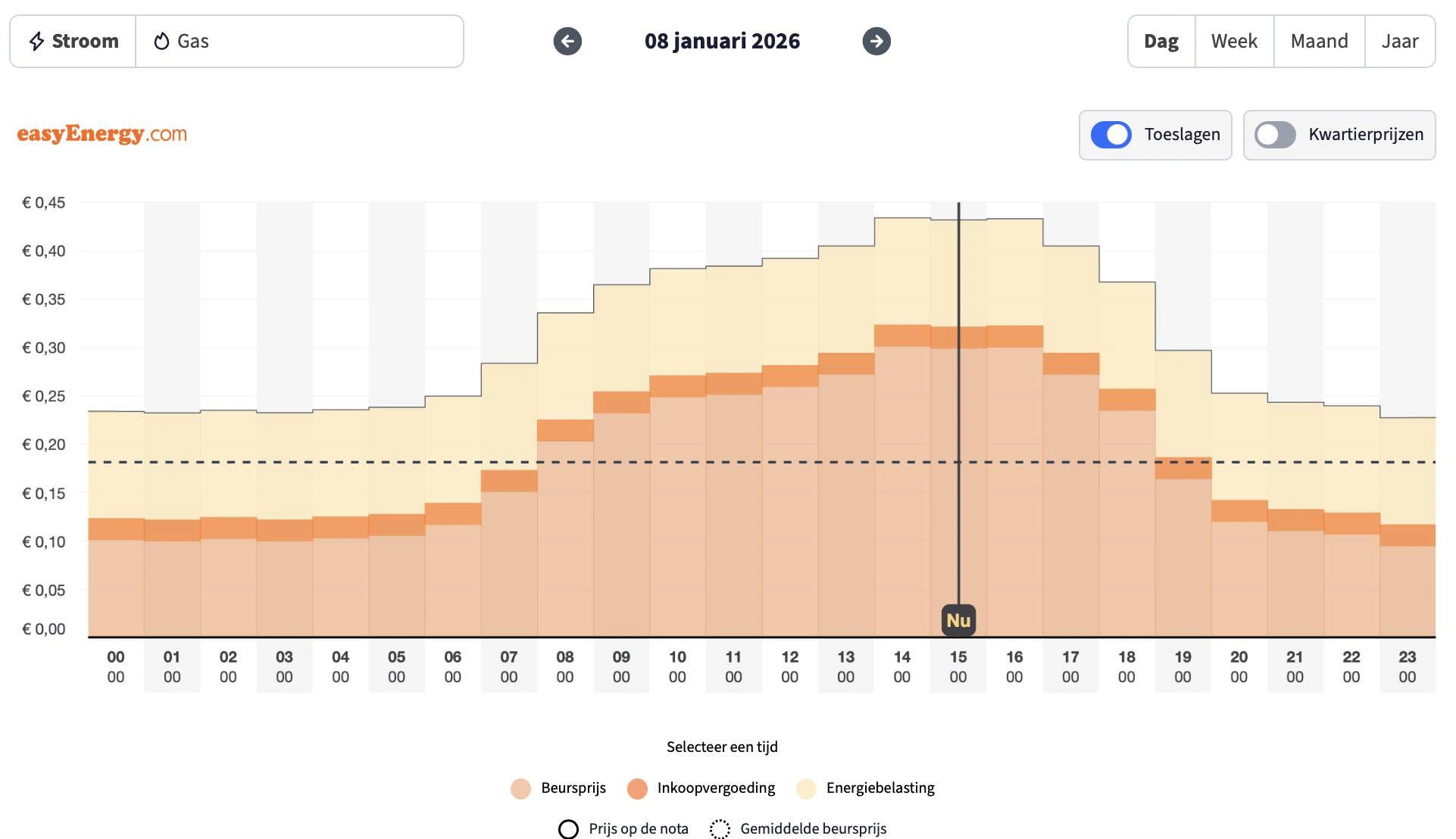
On some days the difference between the lowest and highest rate is big enough to take advantage of (source: EasyEnergy)
Imbalance trading works very differently: Here, a company uses your battery as an instantaneously available off-take or feed-in medium, helping to balance out fluctuations on the grid. These fluctuations result from unexpected peaks and troughs in electricity supply and demand, and are therefore completely unpredictable. However, they can be very profitable, because maintaining grid balance is invaluable to electricity companies.
If you want to use your home battery for imbalance trading, you essentially hand over the management of the battery to another party. You then have no control over how much power flows in and out of the battery. The trading party that uses your battery offsets the earnings on the imbalance market with your energy bill. These earnings are unpredictable and also difficult to verify retrospectively. However, according to the parties involved in this form of trading, they could be quite profitable.
After a year of experience with both the imbalance market and dynamic energy tariffs, we're interested to know which one yielded the most profits. According to providers like Frank Energie, a battery with 10 kWh of capacity on the imbalance market should potentially be able to generate around €2,000 per year. However, in practice, it's turned out less positive, with perhaps a few hundred euros per year at most.
We can estimate the savings you can achieve with dynamic tariffs based on the difference between the lowest electricity price on a given day and the average price you pay for your grid electricity. On some days, this can easily save you a few euros per day. Using a combination of solar panels plus home batteries plus dynamic tariffs, the annual electricity bill of an average household can drop from around €1,000 per year to just around €300, at current energy prices.
After the net metering scheme is abolished on January 1, 2027, the latter combination will certainly offer the greatest advantage, and imbalance trading will likely become a much less attractive option. You can switch from one trading method to the other at any time.
We've also installed backup power for many customers: a smart move, as this provides emergency power if the public grid fails. The advantage of backup power combined with solar panels is, of course, that you have more power than with just a battery, because the solar panels also contribute during the day.
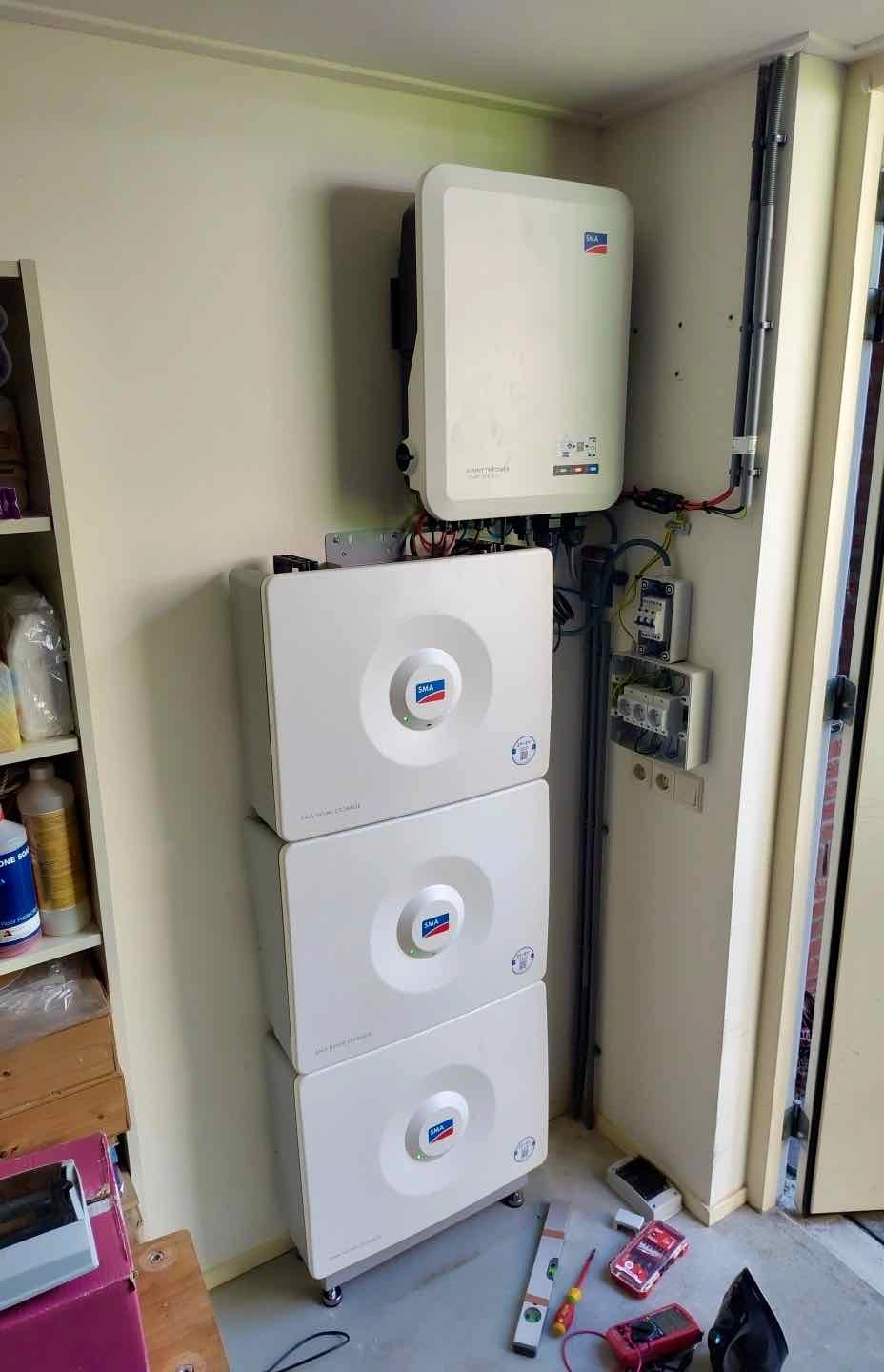
A system with 3 emergency power outlets. In the event of a power failure, each outlet delivers a maximum power equal to the inverter's power divided by three.
Something that has proven to be important over the past year is that customers realize that the backup output of a system cannot supply enormous amounts of power. The backup power is equal to the power of the inverter, and for a three-phase inverter, it is equal to the power of the inverter divided by three per final circuit (for example, for an STPSE5.0 that means: 5000 Watts divided by 3 = approximately 1700 Watts). Many people don't realize that a simple appliance like an electric kettle actually draws a huge amount of power (sometimes more than 2000 Watts), even if it's only for a few minutes. The backup output is fine for things like a refrigerator (which consumes a maximum of 400 Watts), a router (50 Watts), some LED lights (a few tens of Watts), a chest freezer (300 Watts), etc. But don't connect a sandwich toaster (up to 2000 Watts) or a clothes dryer (2400 Watts) to the backup, because that will cause the system to go into safety mode and stop suppolying power!
We've also discovered that combining brands isn't the best idea. For example, if the solar panels are connected to an inverter from brand X, while there's a battery from brand Y, and perhaps also an EV charging station from brand Z, this can cause all sorts of problems: excessive current from the grid, for example, causing the main fuse to trip, or feeding power back into the grid while the battery is still depleted. Having all systems under one roof, with a single app or monitoring portal to view and control everything, works much better.
SMA started testing new ways to control the batteries a month ago. Thanks to a link with the EPEX spot market, batteries can now automatically receive a signal to charge or discharge based on the market price. And SMA EV chargers also participate, allowing you to configure the system so that the car will only be charged when the price is sufficiently low.
The new features will be rolled out to all customers with an SMA hybrid inverter sometime in 2026 (hopefully in the first quarter). We expect that it will then become even easier to save money with the home battery and increase your electricity consumption without spending more on grid power.
Over the past year, home batteries have proven to be a valuable addition to solar panel systems, offering numerous payback options. It's no wonder, then, that interest in them is high and constantly growing. Don't have one yet? Please contact us; we'd be happy to tell you more.
For tips and tricks about the home battery, please visit our knowledge center. Here you'll find, for example: