English
 6 min Reading time
 As we probably all know by now, solar panels are usually installed on a flat or sloping roof. On a sloping roof, they must lie in the plane of the roof, which is usually at an angle of about 30 to 35 degrees. On flat roofs, mounting systems are used in which the panels sit at an inclination of about 12 degrees. Solar panels being placed completely flat on the roof hardly ever happens; if panels are lying flat then dirt can accumulate too easily on them. With a slight incline, the rain will rinse the solar panels clean from time to time.
A low angle of inclination is ideal for solar panels in the summer when the sun is high up in the sky: on those days the panels are bathed in abundant sunlight so that they produce a lot of power. But in the winter it is a completely different story: when the sun hangs low on the horizon and seems to barely rise above the treetops, then the panels that are at an angle of 12 degrees have very little to do.
With the net metering that existed until recently in the Netherlands (before the arrival of feed-in costs!) that wasn't a problem. Your system may have generated ‘too much’ in the summer months, but that excess power simply went straight into the grid. The power you needed in the winter months was offset against the credits from the summer, resulting in low annual elecricity bills.
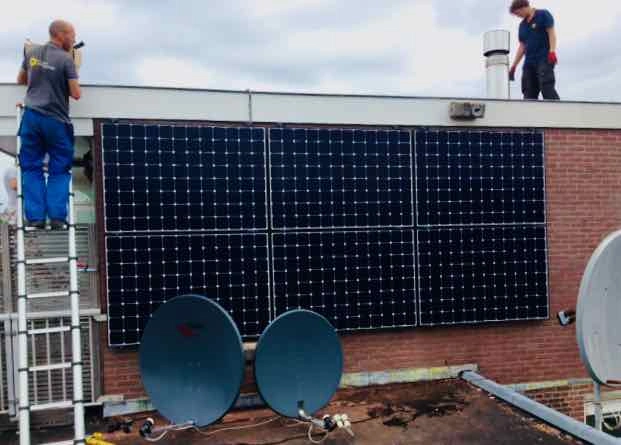
Nowadays, however, things are quite different. Feeding back into the grid is becoming less interesting, whereas generating power when you need it yourself is all the more worthwhile. That is why it is worth looking at solar panels that hang vertically on the wall.
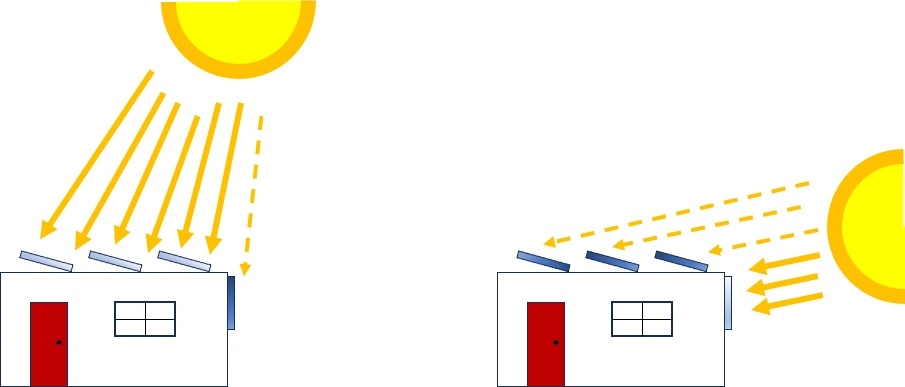
When the sun is high (left, summer) the panels on the flat roof have an advantage, and when the sun is low (right, winter) the vertical panel against the wall has the highest yield
This picture shows an example of a house with 3 solar panels on the flat roof and 1 hanging vertically against the right side wall. In the summer (left), the vertical panel generates much less than the panels on the roof. But in the winter (right), it is the vertical panel that produces the most power.
When we compare a system of 4 SunPower panels on a flat roof with a system with the same panels against a wall, a calculation shows that the panels on the roof generate a lot more power over the year than the vertically placed system. A flat roof installation produces an average of around 1600 kWh per year, while a vertical system remains stuck at 1150 kWh: almost 30% less.
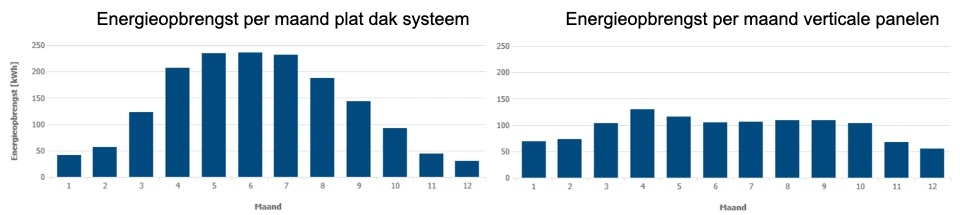
Distribution of power yield over the months of the year, for panels on a flat roof (left) and panels vertically against the wall (right)
But if we look at the distribution of that power production over the year, we can see why vertical panels can actually be an interesting proposition. In the summer months, the yield of the vertical system (right) is clearly much lower than that of the flat-roof installation (left), but in the months of November to February the vertical system produces significantly more solar power.
With the disappearance of the old net metering rules and the introduction of feed-in costs, the surplus solar power in the summer becomes less valuable, while power in the winter months is becoming increasingly expensive. If we look at the hourly spot prices for power around noon, they are much higher in December than in June. The 'all-in' price for electricity in June was around 16 cents per kWh, while in December it was around 31 cents per kWh, i.e. almost twice as high!
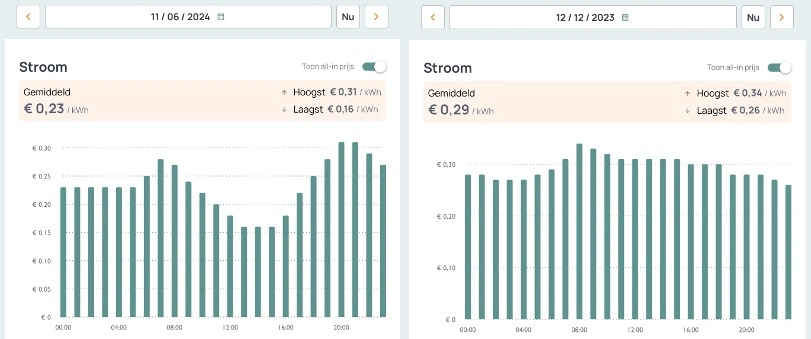
In summer (left), electricity is a lot cheaper around noon than in winter (right) (source: energy-zero)
From this perspective, installing vertical panels is not such a crazy idea, perhaps even as an addition to an existing solar power system. However, you do need to take a number of things into account, particularly with regard to the environmental permit (omgevingsvergunning). Panels on the roof are generally permit-free, but a permit is often required for panels against a wall or a facade. You can obtain information about this from the environmental desk (omgevingsloket) in your municipality.
Furthermore, shade is of course also important. Make sure that the piece of wall you had in mind isn't affected by the shadow of trees or of the neighbouring house in the winter. And finally: if it concerns an extension of an existing PV system, we need to look carefully at how these panels can best be added, and whether a new inverter may be required.
In addition to home batteries, heat pump boilers and charging stations for electric cars, solar panels against the facade or wall can also be a great way to increase your self-consumption and save on electricity costs. Our advisors would be happy to discuss the options with you.