English
 8 min Reading time
 Warranties on home batteries are a bit like warranties on solar panels: there are two different warranties for each product, namely a product warranty and a performance warranty. Each battery manufacturer has their own warranty conditions. In this article we explain the differences between batteries from different brands. We looked at the batteries that Zonnefabriek currently installs (SMA, BYD and SunPower).
The home battery product warranty provides coverage if the device shows real defects: in other words, if the battery simply stops working. Most batteries have a product warranty period of 10 years. This means that if anything breaks in the battery in the 10 years from the time of installation, you can seek redress from the manufacturer.
Just as with solar panels, you as a consumer do not have to contact the battery manufacturer directly, but you do so through your installer (in our case: Zonnefabriek). Only if your installer has gone bankrupt, you should contact the manufacturer direct. They will then ask another installation partner to repair or exchange your device. In some cases, the manufacturer may choose to offer you money instead of repairing or replacing the battery.
The table below shows the product warranty periods for different battery brands
Brand | Duration of the product warranty |
SMA Home Storage | 10 years |
BYD HVS/HVM | 10 years |
SunPower Reserve | 10 years |
An important condition for the warranty is that the batteries are not exposed to temperatures lower than -10 C or higher than 50 C. The batteries must also have a good internet connection (via the inverter) so that the software always remains up-to-date.
The performance warranty indicates how well the battery must continue to work after a certain period of time. The storage capacity of all batteries decreases with time. If they are used intensively, their capacity decreases faster than if they are rarely used.
For most batteries the performance warranty term is 10 years, only SMA Home Storage batteries offer 12 years. The warranty usually states that after this period the battery still has at least 60% of its original storage capacity, unless the battery has been charged and discharged more than a pre-specified number of times within the performance warranty period.
The limit of how intensively the battery can be used before the performance warranty expires is often indicated by a value called the 'energy throughput'. This value is expressed in MWh (MegaWatt-hour, 1 MWh = 1,000 kWh) per kWh, or MWh/kWh. What exactly does this number mean, and how does it relate to the number of charging cycles?
One full charge cycle means that the battery starts empty, is charged with the total amount of energy it can hold, and then discharges completely again, to zero. The energy throughput of 1 charging cycle is therefore equal to the capacity of the battery. For example, if we take a 10 kWh battery, the energy throughput of 1 charging cycle is equal to 10 kWh. If the same battery is fully charged and discharged again the next day, the total energy throughput is then 20 kWh. And if it happens 3000 times in a row, then the energy throughput of that 10 kWh battery is equal to 30,000 kWh. Calculating back to 'MWh per kWh' gives: 30,000 kWh divided by 10 kWh = 3,000 kWh/kWh, or 3 MWh/kWh.
As an example a battery manufacturer can set the following performance warranty condition : we guarantee that the battery still has at least 60% of its original capacity, either after 10 years or after 3 MWh/kWh. This means: the battery still has at least 60% of its capacity after 10 years unless more than 3 MWh per kWh has flowed through that battery. To determine how many guaranteed charging cycles that is, we must calculate back from energy throughput to the number of charging cycles. An energy throughput of 3 MWh per kWh is equal to 3000 kWh per kWh. This means that a maximum of 3000 kWh of energy has been transferred through each kWh of battery capacity, i.e. that the battery has gone through 3000 charging cycles.
The battery does not have to be fully charged and discharged to 100%: for example, if a battery with a capacity of 10 kWh is charged to half capacity (5 kWh) and discharged again twice in a row, then that would be the same as if it would be charged and discharged once all the way to 10 kWh: the energy throughput is 10 kWh in both cases.
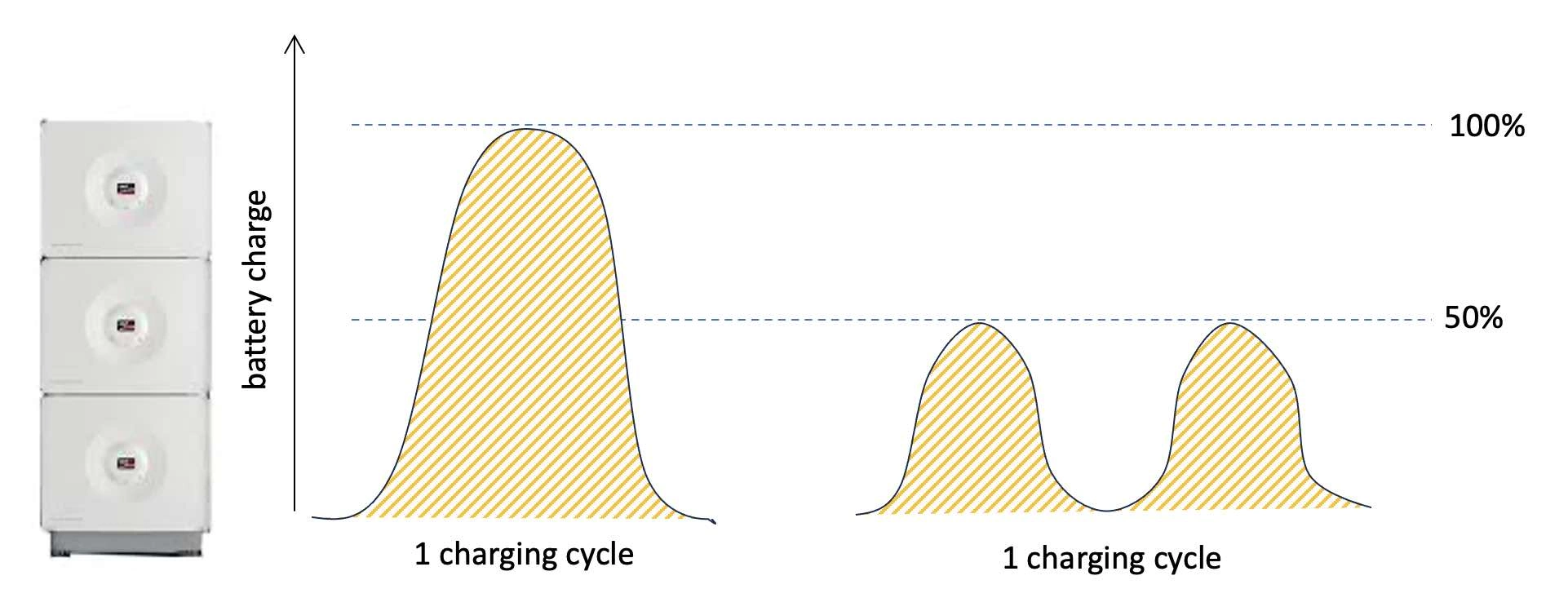
Whether a battery is fully charged and discharged once, or charged halfway and discharged twice, the energy throughput is the same
In their warranty conditions, SMA and SunPower provide one figure for the energy throughput value in MWh/kWh per battery. Battery manufacturer BYD does things a little differently: they give a certain energy throughput in MWh for each different size of battery (for example 5.12 kWh) (in this case 15.41 MWh). To then calculate back to the energy throughput per kWh, we must divide 15.41 by 5.12. We have listed the values for the guaranteed energy throughput for different battery types in the table below.
Battery brand/model | Duration of the performance warranty | Maximum guaranteed throughput energy | Minimum guaranteed capacity |
SMA | 12 years | 7,2 MWh/ kWh | 60% |
BYD HVS | 10 years | 3 MWh/ kWh | 60% |
BYD HVM | 10 years | 3,1 MWh/ kWh | 60% |
SunPower Reserve | 10 years | 3,1 MWh/ kWh | 70% |
What is striking is that the SMA batteries guarantee a lot more energy throughput than the other brands. According to SMA, that 7.2 MWh per kWh would even mean a total of 8,000 cycles. This is because degradation is taken into account: if the battery only has 90% of its original capacity after a few years, then 1 cycle consists of less energy than in the beginning. So with 7.2 MWh/kWh you still get 8000 cycles instead of 7200 (about 10% has been added).
So let's assume that with SMA you are guaranteed to be able to charge and discharge the battery about 8,000 times within 12 years, while with BYD or SunPower batteries you can do this about 3,400 times within 10 years. But what does that actually mean? How many times are you really going to want to fully charge and discharge the battery within that period?
That depends entirely on how the batteries are used. If you have them purely to increase self-consumption, you will never reach the maximum number of cycles. If you only store the surplus solar power during the day to use it again in the evening and at night, you will get at most 1 cycle per day in summer and not even a quarter of a cycle in winter on many days.
However, if you want to use the batteries in a way that makes smart use of so-called dynamic energy rates (the ones that vary hourly), you will want to charge and discharge the batteries at least every day, and sometimes several times a day. In that case, the battery will easily go through 7000 cycles within the first 10 years.
Batteries are not cheap and it is therefore important to have a good idea of the warranties on the product you choose. That's how you can protect your investment as much as possible.
If a battery has reached its guaranteed energy throughput, this does not mean that it will immediately break down. Today's lithium-ion batteries (all brands use Lithium Iron Phosphate or LiFePO4 technology) last a very long time, even though the storage capacity decreases over time. Most systems are expected to last at least 15 years.
Customers who get the most out of it (both for self-consumption and with regard to the dynamic electricity rates) will certainly recoup their costs within that period and also make a reasonable return on the investment. So might a home battery be something for you? Call or email us, we would be happy to discuss it!
You will find the downloadable warranty conditions for the various batteries below.